
Do social media campaigns really have the power to create change, or are we all just wasting time signing online petitions and adding hashtags?
We live in a global village where social media allows us to witness the experiences of people on continents we may never visit. This has created a powerful platform for exposing injustice and amplifying the voices of people with different lived experiences. Many of us were not in America during the height of the Black Lives Matter movement, yet the struggles of Black communities were brought into global view, and people across the world found ways to stand in solidarity. As violence against women continues to rise unchecked, an important question remains: can online activism be used not only to spread awareness, but also to force real change?
From Online Petition to National Pressure
Women For Change South Africa is an organization that raises awareness about violence against women and children in South Africa and advocates against gender-based violence. The organization was founded by Sabrina Walters in 2016 after the murder of a teenage girl prompted her to take action against gender based violence in the country.
Since then, the organization runs on all social media platforms and has been used to spotlight the stories of women who have lost their lives to gender-based violence and to call out perpetrators. Through its strong social media presence, the organization has spotlighted the stories of women who have lost their lives to gender-based violence and has publicly called out perpetrators.
In 2025, the organisation focused on one specific mission: pressuring the South African government to declare gender-based violence and femicide (GBVF) a National Disaster. Such a declaration matters because it would mobilise resources, urgency, and coordination across government departments to address the crisis. It would mean stronger commitment to protecting women and ensuring perpetrators are brought to justice. To support this call, Women For Change launched an online petition that gathered close to a million signatures.
However, on 5 November 2025, the National Disaster Management Centre responded with a letter rejecting the petition. The letter argued that there were already existing frameworks to deal with the crisis. According to the head of the Centre, GBVF could not be “reasonably and rationally” regarded as a disaster. The response was deeply disappointing and revealed what many saw as the government’s apathy toward the issue.
Rather than backing down, the organisation intensified its efforts. It strategically used the G20 summit, which was held in South Africa that year, as a moment to push the issue even further into the spotlight. Since the summit is an annual gathering of leaders from some of the world’s most powerful countries to discuss major economic, social, and sustainability issues, it provided the perfect stage. Launching a campaign while the world’s attention was already on South Africa meant the government would be under even greater pressure to respond.

How the Purple Movement Turned Awareness into Action
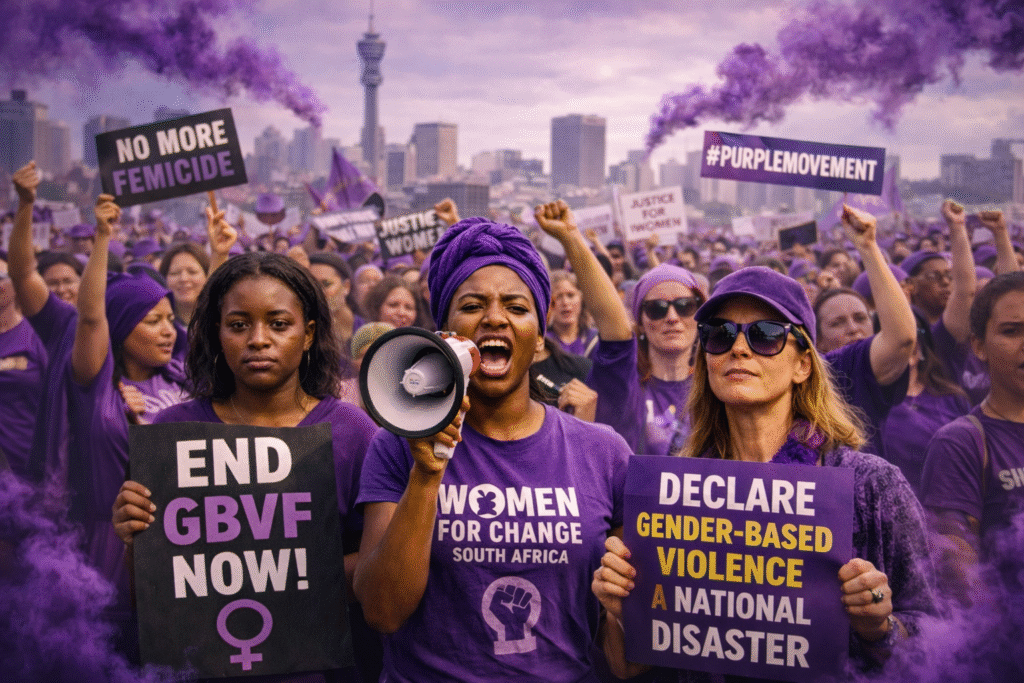
This gave rise to the Purple Movement. In solidarity with the women of South Africa, people across the world changed their profile pictures to purple. As the campaign gained momentum, celebrities began joining in, using their platforms to demand that the South African government take the crisis seriously. Iconic landmarks in South Africa, including the Mall of Africa and Mandela Bridge, were lit up in purple in support of the movement.
The activism did not remain online alone. Women were also called upon to refrain from doing business and participating in the economy on 21 November 2025. At noon, they were asked to lie down for 15 minutes in honor of the 15 women reportedly murdered every day. This powerful act of protest linked digital activism with physical public resistance, making the campaign impossible to ignore.
Eventually, the South African government changed its stance. The National Disaster Management Centre announced that, after a “thorough re-assessment,” GBVF did qualify as a disaster under the Disaster Management Act. During the G20 Social Summit, President Cyril Ramaphosa officially declared gender-based violence and femicide a National Disaster. This was a major victory and a powerful demonstration of what digital activism can achieve when it is organised, sustained, and strategically timed.
Too often, online movements are dismissed as mere trends. It can seem almost foolish to believe that something as simple as changing a profile picture to purple could lead to significant policy change. Yet movements like the Purple Movement and #MeToo show that social media can be far more than symbolic. It can build pressure, mobilise communities, and push governments toward reform.
As we celebrate Women’s Month under the theme Give To Gain, this moment reminds us that using our platforms matters. See an online petition? Sign it. Come across a page highlighting injustice? Repost it. Support campaigns that protect women and girls. These small actions may seem insignificant on their own, but together they can shape public opinion, influence policy, and improve women’s lives.
Author:
Tafadzwa Mavindidze